


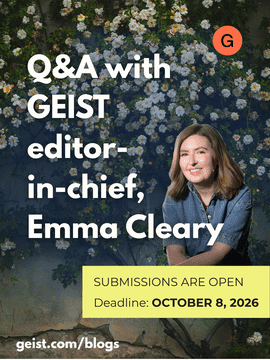
We’re midway through our submissions window for non-fiction, poetry, fiction, and comics, so we caught up with our editor-in-chief, Emma Cleary, to talk about what she’s been reading, what keeps her turning the page, and how an issue begins to take shape. If you’ve ever wondered what happens after you click submit, this conversation offers a glimpse into the pleasures and particulars of the submissions process at Geist.
The deadline to submit is October 8, 2026. Read on, then send us your best work.
What are you looking for when you’re putting an issue together?
We're always looking for extraordinary storytelling. One of the main things I look for in any individual piece is a sense of movement. The ultimate “yes” is when I almost forget I’m considering it for publication. I’m so invested in reading the next sentence and the next: the prose is carrying me somewhere.
When I have the first two narrative non-fiction pieces—one dispatch and one longer feature essay—I can begin to see correspondences. From there, I’m thinking about variation and relationship, how the pieces sit alongside one another, and the rhythm, shape and tone of the issue as a whole.
I’m often drawn to work that has a subtle thread of eeriness, especially in essays about landscape, history, folklore or ecological threat. I have a weakness for poetry that transforms the everyday: we published two gorgeous poems by Evelyn Lau in issue 133—one about plumbers and the other about a sit-to-stand exercise class. We love weird fiction that’s character-driven, emotionally resonant, and that has some connection to the contemporary moment.
Geist’s fascination for lists, letters and maps—which is to say, the handmade, the textual and material, and writing about place—drew me to Geist as a reader long before I became editor. I want reading the magazine to be a tactile experience as well as an imaginative one.
Are there any kinds of submissions you wish you saw more often?
Writing that feels like I’m discovering something along with the author, and that trusts the reader enough to make their own connections. There’s real pleasure in following a writer around while they become interested in something very specific. Their curiosity becomes the engine of the piece—whether it’s about a place, an object, an item of clothing, or a social phenomenon. That’s why I’m still thinking about Connie Kuhns’ essay on Yoko Ono (#114), Gabrielle Marceau on the image of the falling woman in cinema (#123), and an essay on the dark sky movement Suzannah Showler wrote for Harper’s a few years ago.
I’d like to see more cultural criticism that begins with a genuine fascination, that asks questions about how things acquire significance, and how that significance changes over time. I’m always searching for pieces that take place within a broader community beyond the immediate family, and ones that include interesting fields of work, practices or hobbies. I love psychogeographic writing—on walking the city, the coast, or some other environment—because it captures so much of life and thought. I adored these moments in Kasia Van Schaik’s The Uncreative Life in issue 131, where she describes working as a nanny, pushing a stroller through an upscale Berlin neighbourhood and peering into aquarium-like kitchens.
On a more practical level: shorter essays of 1,500 words or less, and fiction of around 2,000 words. It’s rare I ask a writer to go longer in a piece; I’m often asking them to cut.
You recently published your first novel, Afterbirth. Can you tell us a bit about it and what you learned from that experience?
Afterbirth is a queer literary horror novel about two sisters grappling with the idea of motherhood and the seductiveness of art. It’s interested in the feminine grotesque in horror cinema and visual art, like Cindy Sherman’s Untitled Film Stills, and in the ways women’s bodies, desires and fears have been made monstrous. I’ve seen it described as femgore; the term I use a little wryly in the book is “mommy horror.”
Being a debut author has made me even more aware of the generosity involved in the whole process, and the importance of community. It’s also renewed my conviction in the vital role of lit mags within the publishing ecosystem, as a place where writers can develop their ideas and their style, and for readers and writers to find each other. These things all sustain a longer work like a novel.
I’ve said this elsewhere but it bears repeating: as an editor, I’m interested in preserving a writer’s distinctive style and the narrative digressions that make writing feel alive. Sheila Heti once called Geist “human sized with a genuine heart,” and that feels essential in the moment we find ourselves living in.
Finally, what are you reading right now?
I’m rereading Swing Time by Zadie Smith, about to begin Said the Dead by Doireann Ní Ghríofa, and savouring Billy-Ray Belcourt’s The Idea of an Entire Life.
Submissions are currently open across all categories for our 2027 issues. Deadline: October 8, 2026. You can submit here.
Our priority is to publish writers and artists from across Canada. We encourage submissions from Black writers, Indigenous writers, writers of colour, writers with disabilities, LGBTQIA2S+ writers, and writers from other intersectional and marginalized groups. We offer no-fee submissions for BIPOC writers and artists via our Submittable page, and a limited number of no-fee submissions for low-income writers. Please read our submission guidelines for more details.
All submissions must be original and previously unpublished. Geist is not interested in submissions that have been generated or developed with the use of AI, and we do not consider these to be original work.
SIGNUP TO OUR NEWSLETTER

SIGN-UP TO OUR NEWSLETTER
.png)
