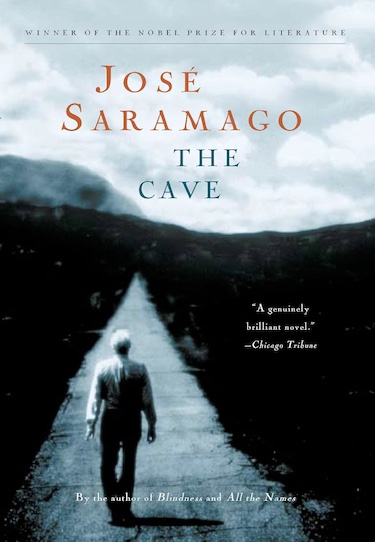
You could be forgiven for at first believing that José Saramago used a speech-to-text app when writing his novel The Cave (Harcourt) and forgot to tell the app to insert punctuation. Every one of the 307 pages in my paperback translation (by Margaret Jull Costa) looks exactly like every other page: there’s not a whisper of punctuation beyond the very occasional period. There’s a great deal of talking with no quotation marks. There’s no paragraphing, and the text is justified right as well as left. Thank goodness for chapter breaks (though without headings or numbers, of course). And to compound the lack of visual clues, very little seems to happen. So why is the book so readable, so compelling, despite all this? For characters, we have: a widower potter, his assistant potter daughter (mea culpa), her security-guard husband and an adopted stray dog they call Found. Yes, the dog has an inner life and observes the lives of the other three, but always remains very much a dog. Why do the destinies of these characters matter? A fifth character, perhaps, is The Centre, the looming monolithic urban complex several hours drive from the semi-rural pottery, arbiter of commercial (and political?) power, that seems to offer our friends salvation and damnation, both. The destinies of the other four do matter, so perhaps the real question is: how do we find ourselves willingly seduced into their minds and hearts? How has the writer done it? Open The Cave anywhere—the pages all look more or less the same. Every line is packed with the minutiae of our inner workings, our hopes, fears, insights, delusions, resilience, our love for each other, everything that is banal if unexamined, but epic under Saramago’s microscope. His pages, like life, seem formless until we read them. —D. G. Shewell
David Shewell is a travel writer and reviewer turned writer of short fiction, now working on his first novel. A native of Ottawa, he settled in the UK for no particular reason, and has lived in Vancouver for the past four decades.
SIGNUP TO OUR NEWSLETTER

SIGN-UP TO OUR NEWSLETTER