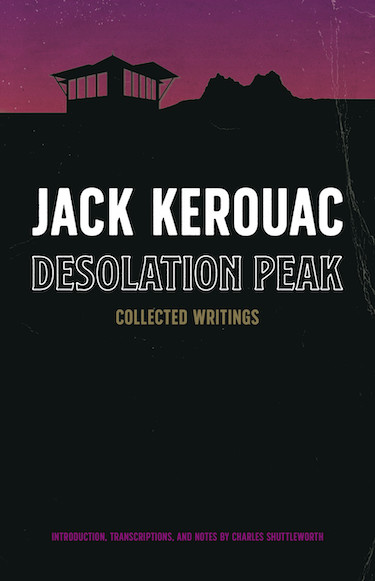
My first “book as Bible” was Jack Kerouac’s On the Road. I once donated a hardcover copy—soon stolen, I imagine—to the reading room of Shakespeare & Company, George Whitman’s Paris bookstore, in the belief that I was evangelizing for some sort of poetic truth and a vagabond way of life. Kerouac’s 1956 summer as a fire lookout in the North Cascades formed the basis of two later books, The Dharma Bums (1958) and Desolation Angels (1965). Reading them, I imagined Kerouac in his lookout cabin, gazing north past Mount Hozomeen—“most beautiful mountain I ever seen”—and across the Canadian border into southern BC. Desolation Peak: Collected Writings (Rare Bird Books) offers a fascinating glimpse into that fire lookout summer, with an introduction and notes by Charles Shuttleworth, and a complete transcription of Kerouac’s shirt-pocket notebook. There’s even a photographic insert, with reproductions of some of the notebook’s pages, including drafts of haiku, or “pops” as Kerouac called them, and a meticulous tracking of his finances. One of the pages is a list of things to buy when he’s done: “Hornrim dark glasses,” “Red bandana,” “New Jeans size 33-30.” Desolation Peak also contains Kerouac’s notes toward a pair of unfinished novels, “Ozone Park” and “The Martin Family.” In “Ozone Park,” Kerouac chronicledhis life from June 1943 to May 1949 and the acceptance of his first novel The Town and the City. He intended “The Martin Family” to be a sequel to The Town and the City. As a testament to the enduring power of the Kerouac myth, people still make the trek every summer—a thirsty climb of 3,400 vertical feet—from the shore of Ross Lake to that original lookout cabin, which still sits atop Desolation Peak.
SIGNUP TO OUR NEWSLETTER

SIGN-UP TO OUR NEWSLETTER