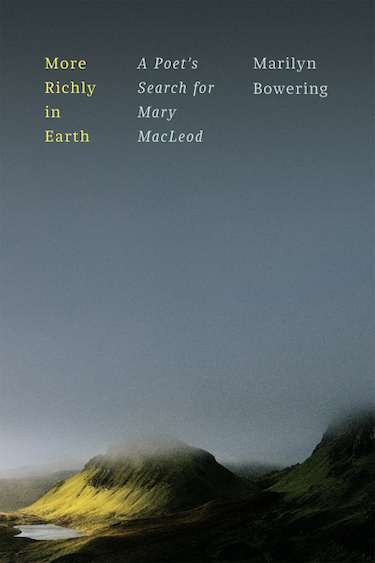
More Richly in Earth: A Poet’s Search for Mary MacLeod (McGill-Queen’s University Press) is Marilyn Bowering’s account of her investigations into the life of Mary MacLeod, a seventeenth-century poet of the Scottish Hebrides. Poetry was political back then, and MacLeod’s surviving works—Gaelic songs, poems and panegyrics—often praise the accomplishments of the lairds and clan chiefs who served as her patrons and sponsors. But the details of MacLeod’s life are in dispute, and Bowering, who is a poet and novelist living in Victoria, BC, comes to feel “as if I am carrying water or sand as each fact I come across slips through my fingers.” The result is a text studded with uncertainty: “Mary’s mother was (perhaps) of the MacLeod’s of Morar”; “a sister appears to have lived . . .”; “Likely of low economic status . . .”; “Mary is thought to have . . .” [italics mine]. Even the dates of MacLeod’s birth and death are in doubt, as is the reason for her “notorious” burial treatment (“placed face downward in her grave”). This may have been at her own request, “to repudiate her own work”—but it could also have been imposed as a punishment (face-down burial being “usually reserved for those accused of witchcraft”). Bowering’s deep attachment to the land and people of Scotland dates from her twenties, and her descriptions of the landscape give this book a luminescence and vitality: a walk through heather up the shoulder of Creag na Caillich; driving the single-track roads of western Scotland in a British-racing-green MGB, “through ice and snow and fog” over the Bealach na Bà pass. Though published by a university press, More Richly in Earth is so much more than another dry, academic treatment of an almost-forgotten poet; Bowering’s writing sings, and as you read it, you can almost feel the wind coming off the Minch, driving rain before it. —Michael Hayward
SIGNUP TO OUR NEWSLETTER

SIGN-UP TO OUR NEWSLETTER